Unlocking the Matrix: 3 Surprising Truths Hidden Inside Business Software
Unlocking the Matrix: 3 Surprising Truths Hidden Inside Business Software
Most of us use software every day, clicking through interfaces and entering data without giving much thought to the underlying structure or philosophy that guides our actions. These digital tools are more than just collections of buttons and fields; they are complex systems built on a specific, often invisible, data model for how the business world works.
By examining a specialized piece of business software, "PROTO Flow Enterprise," we can pull back the curtain and see some of these foundational principles. Looking "under the hood" reveals a surprisingly insightful and counter-intuitive architectural philosophy for organizing a business—from how a potential customer is defined to who is considered part of the company's ecosystem. This article explores three of the most powerful truths hidden inside this system's design.
1. Before a Lead is a 'Lead', It’s a 'Suspect'
Many sales and marketing teams use the general term "lead" to describe any potential customer, often leading to inflated pipelines and murky forecasts. PROTO Flow, however, implements a far more precise, three-stage data model for the sales funnel that enforces a powerful level of operational discipline.
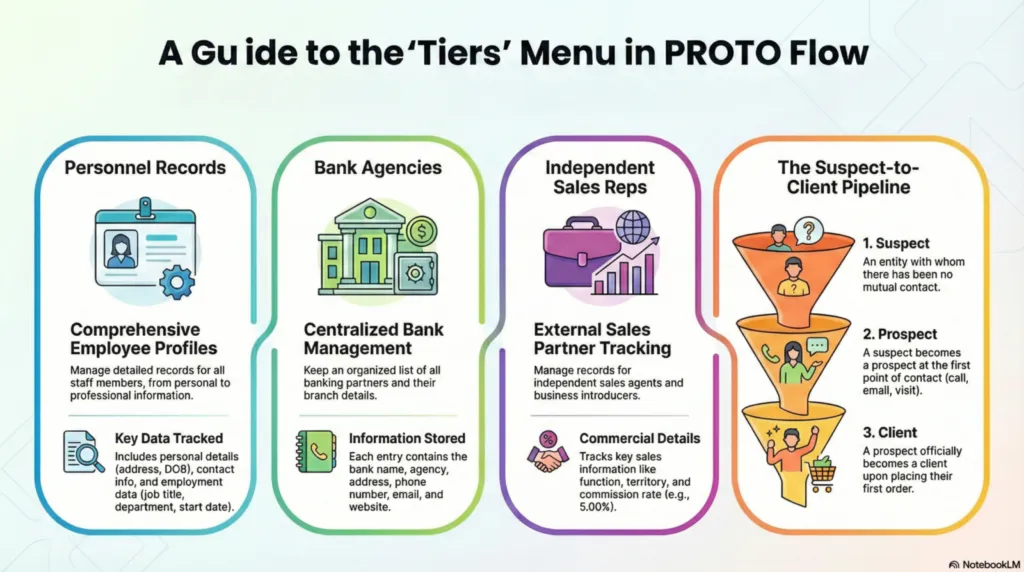
The system defines the journey from an unknown entity to a paying customer with clinical precision:
- Suspect: An entity with which there has been zero contact initiated by either side.
- Prospect: A "Suspect" becomes a "Prospect" at the very first moment of contact, whether it's a phone call, mailing, or visit. At this stage, the entity is moved to the main Client/Prospect database where CRM activities can begin.
- Client: A "Prospect" officially becomes a "Client" the moment they place an order.
The system's core philosophy on this initial stage is perfectly captured in its documentation:
"In PROTO Flow, a 'Suspect' has never contacted the company, and the company has never contacted the suspect."
This rigid, black-and-white definition is more than a semantic curiosity; it’s a strategic business advantage. By creating a hard distinction between a "Suspect" (an uncontacted name) and a "Prospect" (an engaged entity), the system prevents sales pipeline inflation. It establishes a crystal-clear handoff point: marketing may generate lists of suspects, but only sales can create prospects through action. This discipline ensures that sales forecasts are built on a foundation of actual engagement, dramatically improving their accuracy and reliability.
2. The System Captures Everything
PROTO Flow is designed to be an exhaustive, central repository of information. The level of detail its data model aims to capture about a single individual is staggering, creating a comprehensive digital file that blends professional and deeply personal data.
The personnel record for an employee named "AUBERT SERGE" serves as a potent example. The system tracks not just his professional role but a vast array of personal data points in the same record:
- Professional: Poste (PRODUCTION), Secteur (TOLERIE), Fonction (CHEF EQUIPE - Team Lead)
- Personal: Émail perso (mail_perso@gmail.com), Mobile (06.70.56.76.06), Naissance (18/09/1958), Statut familial (Marié - Married), No Sécurité sociale (158095415921722)
This commitment to detail extends to all entities, such as the "GREVY" agency of BANQUE POSTALE, which has its full address, agency email, and website codified. While centralizing data offers immense power, this specific architectural choice—unifying sensitive personal information with operational data in a single employee record—raises critical questions. It blurs the lines between an employee's personal and professional identity within the corporate data ecosystem, creating significant implications for data governance and privacy compliance under regulations like GDPR. It moves beyond simple record-keeping into a full-fledged digital dossier.
3. Everyone is a 'Third Party': Employees, Banks, and Sales Reps
In conventional business language, a "third party" is an external entity—a customer, a supplier, a partner. An employee is, by definition, a first party. One of the most revealing architectural principles in PROTO Flow is its complete rejection of this distinction. The main menu for managing contacts is labeled "Tiers," which translates to "Third Parties," and its contents are profoundly counter-intuitive.
This single menu consolidates nearly every person or organization that interacts with the business, treating them all as nodes in a single, unified data model. The "Third Parties" menu includes:
- Internal personnel (Liste des personnels)
- Financial partners (Liste des agences bancaires)
- Independent salespersons (Liste des commerciaux indépendants)
- Potential customers (Liste des suspects)
This is not a mistake; it is a sophisticated, abstract worldview. The system treats the company as a central point and models every other entity—internal or external—as an object with defined attributes and relationships. The record for "PIERRET MICHEL," an independent salesperson, tracks his Fonction (COMMERCIAL), Secteur (BOURGOGNE), and Taux (commission rate) of 5,00 % with the same rigor as an internal employee. This entity-relationship design reveals a philosophy that a business is not a family but a network of nodes, where every relationship is defined and managed purely by its data.
Conclusion: The Logic Behind the Clicks
Peeking inside the architecture of PROTO Flow Enterprise reveals more than just software features; it exposes a clear business philosophy. The precise language of the sales funnel, the exhaustive approach to data collection, and the holistic, data-centric view of all business relationships are not accidental. They are intentional architectural principles that shape how a business operates.
These hidden structures are present in all the software we use, quietly guiding our processes and decisions. The next time you open an application, ask yourself: what hidden logic and unspoken rules are shaping your digital world?