PROTO Flow customer file
Your Customer Record Is Worth Gold: 5 Unexpected Strategic Levers in Your ERP
For many companies, the customer record within their ERP system is little more than a digital address book: simply a directory of names, addresses, and phone numbers. This is a static and outdated view. The reality of a modern ERP is that it is a dynamic and extraordinarily rich data hub, but most companies only exploit a tiny fraction of its capabilities. This article aims to reveal five surprising and high-impact features of a complete customer record. Using the example of the PROTO Flow ERP, we will demonstrate how to transform this simple database into a true strategic asset for your business.
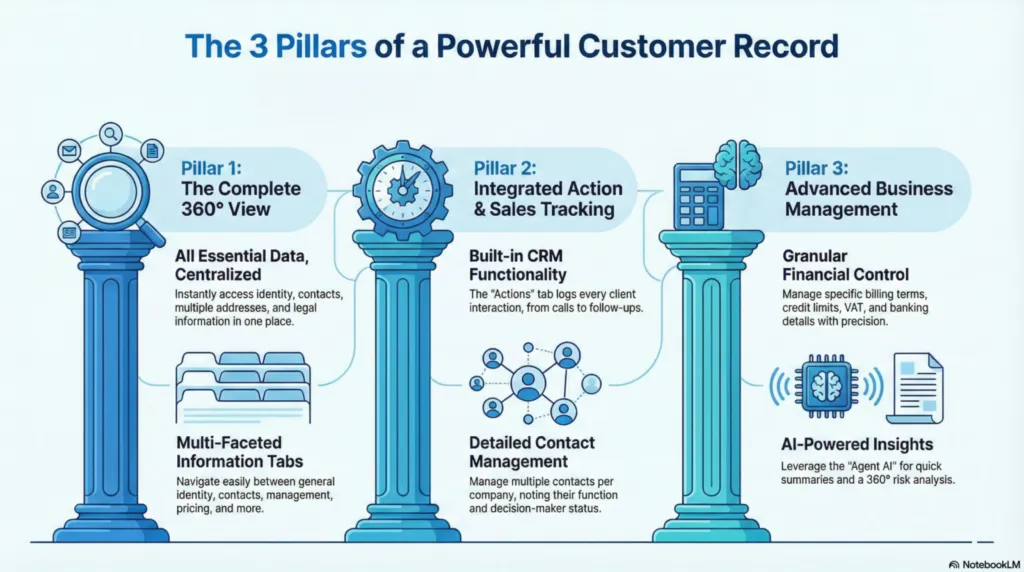
1. The 360° View: Far Beyond Just an Address
A modern customer record centralises much more than just contact details. It aggregates all essential information related to a client in one place, offering a complete and unified view. In the Identity tab, you find general information such as address or email. But the Management tab reveals much greater depth:
- Financial details (Billing sub-tab): Specific payment terms ("BANK TRANSFER 30 DAYS EOM ON THE 10TH"), currency ("EUR"), and applicable VAT regime ("VAT AT 19.60%").
- Legal information (Legal/Bank sub-tab): SIREN number (622034460), NAF code (3092Z), and the client’s bank details.
- Logistics and commercial data (Miscellaneous sub-tab): Delivery methods and the assigned sales representative ("BOURGUIGNON MICHEL").
This centralisation is a major strategic advantage. It eliminates information silos between departments. Whether it’s sales, accounting, or logistics, every team accesses the same single source of truth, ensuring greater consistency and efficiency in all operations.
2. People at the Heart of the Data: Identifying Key Decision-Makers
Behind every client company are individuals. A strong business relationship is built by addressing the right people. The ERP allows for fine management of individual contacts within a client organisation, as shown in the Contacts tab. The most telling feature is the ability, visible in the "Contact Record," to designate a contact as a "Decision-Maker" via a simple "Yes/No" option.
The strategic importance of this simple checkbox is immense. Knowing how to identify key decision-makers streamlines communication, improves the efficiency of sales teams, and builds stronger business relationships by focusing efforts on those with real influence and decision-making power.
3. The Living Memory of Your Customer Relationship
The customer record is not a static archive; it is a dynamic record of the complete relationship history. Several tabs illustrate this point:
- The Actions tab functions as a CRM journal, tracking all past interactions. You can see actions like "Phoning" or "Faxing," with the date, responsible employee, and purpose of the contact.
- The Pricing tab retains specific pricing conditions negotiated with the client, displaying, for example, a sales price of "17,490" for a given product reference.
- The Notes tab allows you to add important contextual information that will appear on specific documents such as the Delivery Note or Invoice.
This institutional memory is a safeguard against commercial amnesia. It prevents a new salesperson from appearing inexperienced and ensures that an account manager can take over a sensitive file with full mastery of the history, thus preserving client trust.
4. Total Flexibility: When the ERP Adapts to Your Business
A powerful ERP should not impose a rigid structure on your company but rather adapt to its unique processes. The concept of flexibility is perfectly illustrated by the User tab. This section contains "Free Fields," allowing the company to fully customise the customer record to capture data specific to its sector or internal processes.
This capability is often underestimated. Imagine tracking non-standard but vital indicators for your sector: a customer satisfaction score (NPS), the date of the last on-site technician visit, or a project identifier specific to a case. The ERP no longer imposes its structure on you; it adopts yours.
5. Artificial Intelligence at the Service of Decision-Making: The AI Agent
The most significant evolution of the customer record is its transition from a passive storage tool to an active analysis platform, thanks to artificial intelligence. The "AI Agent" button embodies this transition, providing access to actions designed to turn raw data into actionable intelligence:
- 360° Risk Analysis: Instantly assess the financial health and potential risks associated with a client, compiling internal and external data for a predictive view.
- Company Information: Obtain up-to-date legal and commercial information without leaving the ERP, saving valuable research time.
- Who Does What, Where?: Instantly identify the main internal and external contacts linked to this account, mapping key relationships for more effective communication.
- On-Screen Record Help: Benefit from contextual assistance that explains fields and data, speeding up user training and adoption.
Having such an AI assistant directly from the customer record enables teams to make faster and better-informed decisions.
Conclusion
In conclusion, the customer record within a modern ERP is much more than a simple administrative entry. It is a powerful strategic asset that offers a complete, historical, and contextual view of the entire customer relationship. From data centralisation to AI assistance, its potential to improve efficiency is immense. Is your company using its customer record as just a database, or as the true nerve centre of its commercial strategy?
If you need a more concise summary or a translation of a specific section, please let me know!